AI-Powered Legal Analysis
Institutional-grade AI analysis with human oversight. Identify risk clauses, missing provisions, and red flags before you sign.
Self-hosted. Your data never leaves your network. Enterprise AI at small-firm prices.

28+ FORMATS, ONE DROP
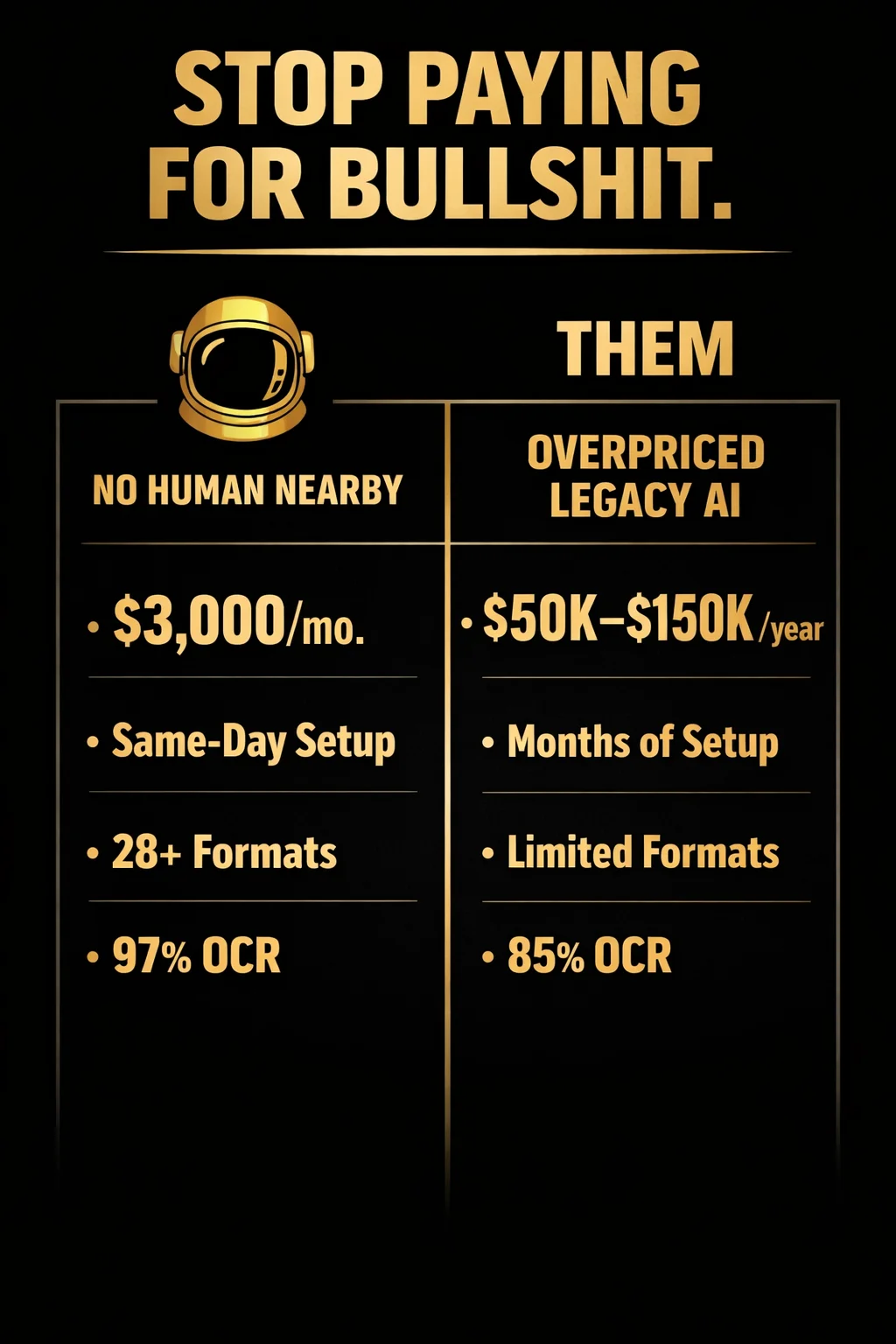
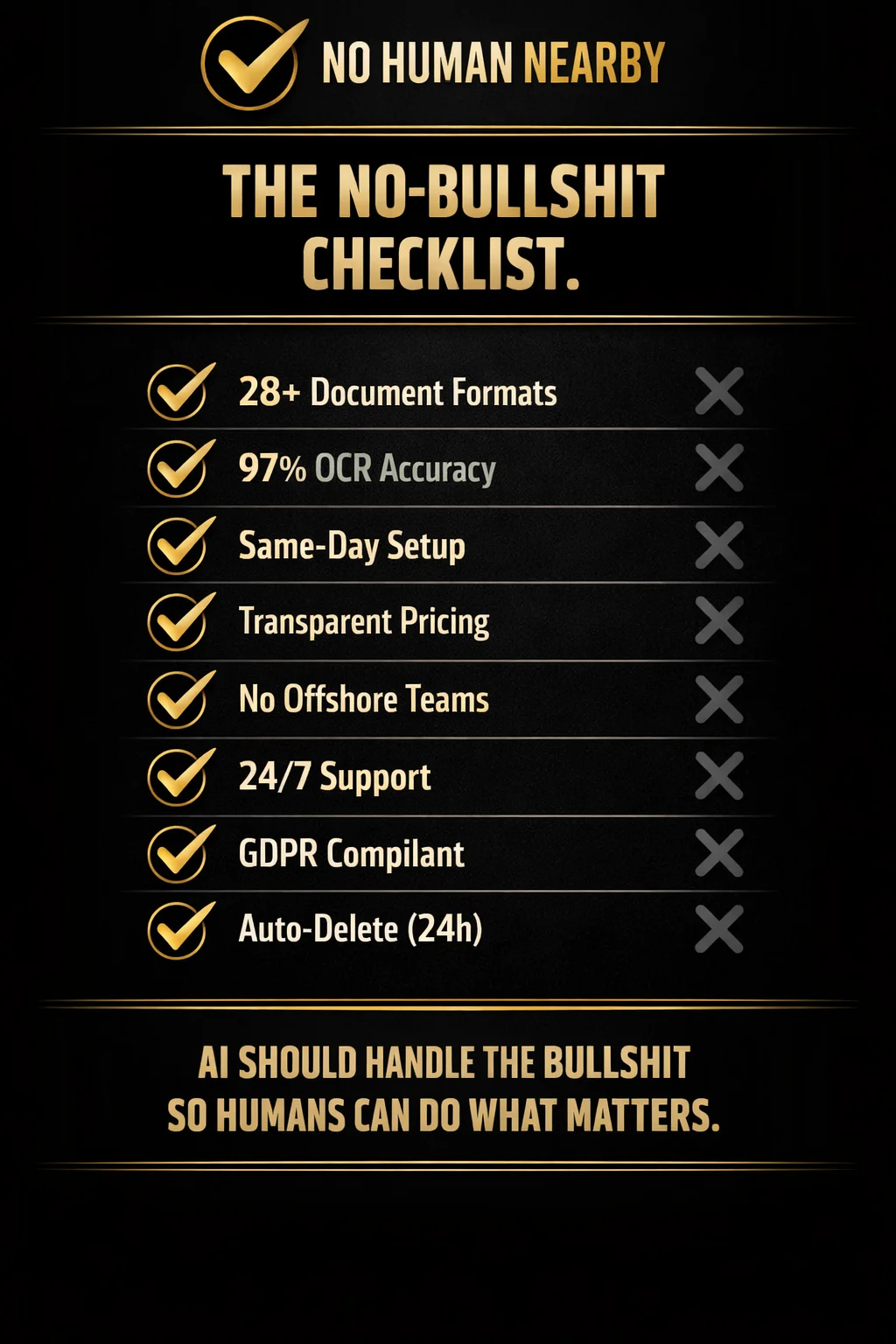
PDFs, scanned faxes, DOCX, Outlook archives, markdown, emails - Redline extracts and analyzes everything in one pass. Most competitors handle 4-6 formats. Redline handles 28+ including ZIP archives of mixed documents.
YOUR FIRM'S PLAYBOOK, AUTOMATED
Select your firm's playbook. Redline compares every clause against your accepted language, side-by-side. Green for matches, orange for deviations, red for missing critical provisions. The enterprise hook your associates have been waiting for.
Recorded demos with realistic data. Live system uses your firm's data and your firm's playbook.
Every hour spent on contract review is an hour not spent on high-value legal work.
Associates spend 2-4 hours reviewing a single contract. At $400/hour, that's $800-1,600 per review that could be allocated to strategic work.
Fatigue leads to oversights. A buried indemnification clause at 11pm could expose your client to millions in liability.
Different associates flag different issues. Without standardized review protocols, quality varies dramatically across your firm.
Every contract your associates review is money on the table. Here's what you're actually paying.
One junior associate reviewing 10 contracts a month costs your firm $16,000. REDLINE replaces that entire line item and returns analysis before the coffee gets cold.
Institutional-grade analysis, delivered in minutes.
Our AI examines every clause against 50+ risk factors, identifying issues that human reviewers might miss.
Every finding is verified by a trained reviewer. No hallucinations. No false positives delivered to your desk.
Receive client-ready PDF reports with risk scores, specific concerns, and actionable recommendations.
A quiet new risk is showing up in 2026 contracts - and most review tools aren't looking for it.
Vendors, SaaS providers, and platforms are slipping language into agreements that grants them the right to train AI models on your client's data, work product, and communications. Buried in Section 12.4. Referenced by defined term. Often indistinguishable from standard data-use language at a glance.
REDLINE flags every one. Our analysis engine specifically hunts for training-rights language that competitors treat as boilerplate - because in 2026, it isn't.
We hear this question a lot. Here's why browser AI is a liability waiting to happen.
Browser AI sends your client's contracts to third-party servers. Every NDA, every M&A document, every settlement agreement - sitting on someone else's cloud.
When opposing counsel asks in discovery "Did you share privileged documents with third parties?" - what's your answer?
Our system keeps data on YOUR infrastructure. That's privilege protection.
Browser AI chat history disappears. When the bar or a client asks what AI reviewed their documents and what decisions were made - do you have receipts?
ABA Formal Opinion 512 requires you to understand where client data goes and maintain oversight of AI tools.
We log every action, every AI output, every human decision with timestamps. Full compliance documentation.
Browser AI gives answers. When the AI misses something and you get sanctioned, whose fault is it? You can't blame ChatGPT in court.
Those "AI does it all" tools are selling you liability. We're selling you protection.
AI flags, humans decide. Every finding is verified before delivery. That's what ABA 512 actually requires.
Source: LawGeex AI Contract Review Study
When you send contracts for "AI analysis," do you know what's actually reviewing them?
Industry reports have revealed that some legal AI companies use humans to perform work advertised as AI-powered. Employees have publicly described reviewing contracts that clients believed were AI-processed.
We built NO HUMAN NEARBY differently.
Genuine AI analysis, not humans pretending. No black boxes. No surprises.
Your documents are processed on our infrastructure. No OpenAI. No Azure. No third-party cloud.
No humans reading your privileged documents behind the scenes. When we say AI, we mean AI.
100% AI. 0% Humans Behind the Curtain.
Most contract review tools choke on anything that isn't a pristine PDF. REDLINE eats whatever your matter coughs up.
PDFs from the other side. Scans of 1987 agreements your client found in a filing cabinet. Outlook archives dumped straight from discovery. A ZIP with 40 mixed documents inside. Drop it in - REDLINE extracts, OCRs, normalizes, and analyzes everything in a single pass.
Your associate spends the better part of a workday on one contract. REDLINE returns the analysis before the next meeting starts.
In the time it takes a first-year to brief one NDA, REDLINE clears the entire week's queue. Your associates stop reviewing and start advising, the work clients actually pay premium rates for.
The 4-hour mechanical reading task becomes a 20-second pass. The lawyer spends those 4 hours on strategy and client relations, the work clients actually pay premium rates for.
2 contracts. 9 billable hours. Zero strategic work.
12 contracts. 8 billable hours. Strategy work the firm couldn't bill before.
"REDLINE isn't replacing the lawyer. It is taking a 4-hour mechanical reading task, reducing it to 20 seconds, and forcing the lawyer to spend those 4 hours on high-level strategy and client relations instead of hunting for typos."
Send your contract via secure portal
28+ formats supported
AI scans for 50+ risk factors in under 5 minutes
Human expert verifies findings and flags priorities
Receive executive PDF report within 24 hours
AI should handle the bullshit so humans can do what matters.
Senior partners do not need to read the model's source code. They need to know the privileged document never left the firm.
"Election officials do not inspect the voting machine's motherboard. They verify physical chain of custody. Same trust model, same reason it works."
The Old Trust Question
Cloud AI vendors have spent years offering "algorithmic transparency" as the reason their products should be trusted with privileged work. Model cards. Constitutional AI. SOC 2 reports. Read the documentation, trust the output.
None of it answers the question partners actually ask: where did the document go, who touched it, and is it coming back.
The REDLINE Trust Model
Physical custody replaces algorithmic transparency. The inference runs on hardware the firm owns, in a room the firm controls, on a network the firm secures. The document is processed and destroyed without a single packet leaving the firm's network perimeter.
The black box is acceptable because it is in your vault, not theirs. That is a trust model the ethics committee already understands.
Most firm deployments stall on one question: "Can IT actually run this thing?" We pre-answered it so yours is a short meeting.
The entire REDLINE hardware spec is a single off-the-shelf Apple Silicon Mac. The unified memory architecture runs the same class of local AI inference that would otherwise require a $45,000-plus discrete-GPU server, at a 10x lower capital cost and a 20x lower 10-year total cost of ownership.
$3,000 to $7,000 capex. Less than 100 watts. No rack. No specialized staff.
Lock in founder pricing before regular subscriptions go live.
Once they're gone, it's full price. Lock in your rate before the next tier fills.